When strained, Mechanoluminescent materials emit at an intensity according to the rate the material is strained. During my research with smart materials, I fabricated and tested ZnS:Cu thin films to characterize their emissivity and luminosity conversion. The results of my research are used in Dr. Donghyeon Ryu’s Lab for Smart Materials to develop flexible and wearable sensors for strain measurements.
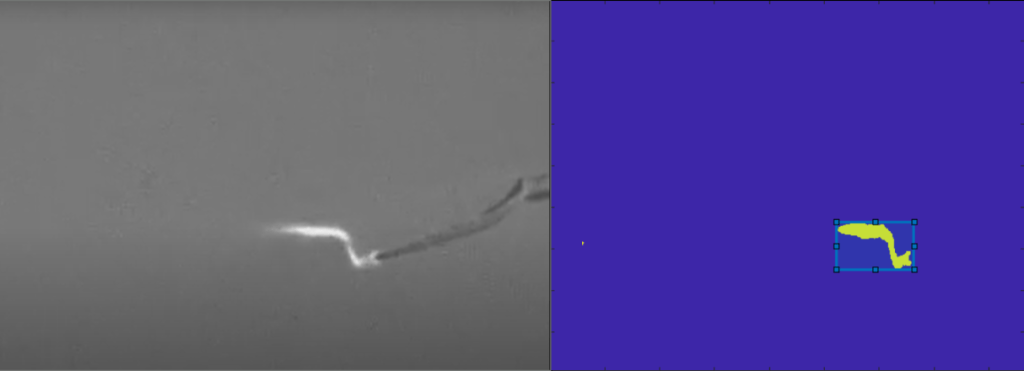
Left: Greyscale video of ZnS:CU-PDMS fracture emitting light at high strain region.
Right: Python ML algorithm sorting image noise and identifying region of interest for each frame of the video.
| What | How | Results |
|---|---|---|
| Stress field characterization using Mechanoluminescent materials | Designed test stand for straining materials under a high-speed camera | Emissivity data based on strain rate in Mechanoluminescent materials |
| Optical absorption classification of new and developing Mechanoluminescent powders | Developed ML algorithms for identifying ROI around a crack tip using pixel values | strain rate models in region around crack tip, enabling smart material sensor design |
| Fabrication of thin-film materials for flexible sensors | Spin-coated copper doped zinc sulfide on PDMS for emissivity testing | Co-author of conference paper to be presented in 2026 |

Image: Specimen design with ZnS:Cu thin films for strain testing, as well as DIC speckles for methodical strain comparison
 Thomas Pierson